
Working at height remains one of the leading causes of workplace fatalities and serious injuries across many industries. Whether employees are conducting maintenance, construction activities, inspections, cleaning, or installation work, selecting the appropriate means of access and work equipment is critical for ensuring safety and preventing falls.
Many workplace accidents occur not because of a lack of equipment, but because the wrong equipment was selected for the task. A ladder used where a mobile elevated work platform would have been more suitable, or an improperly erected scaffold, can significantly increase the risk of falls and injuries.
This article explores how employers, supervisors, and workers can select the most appropriate access equipment for working at height activities while ensuring compliance with safety regulations and industry best practices.
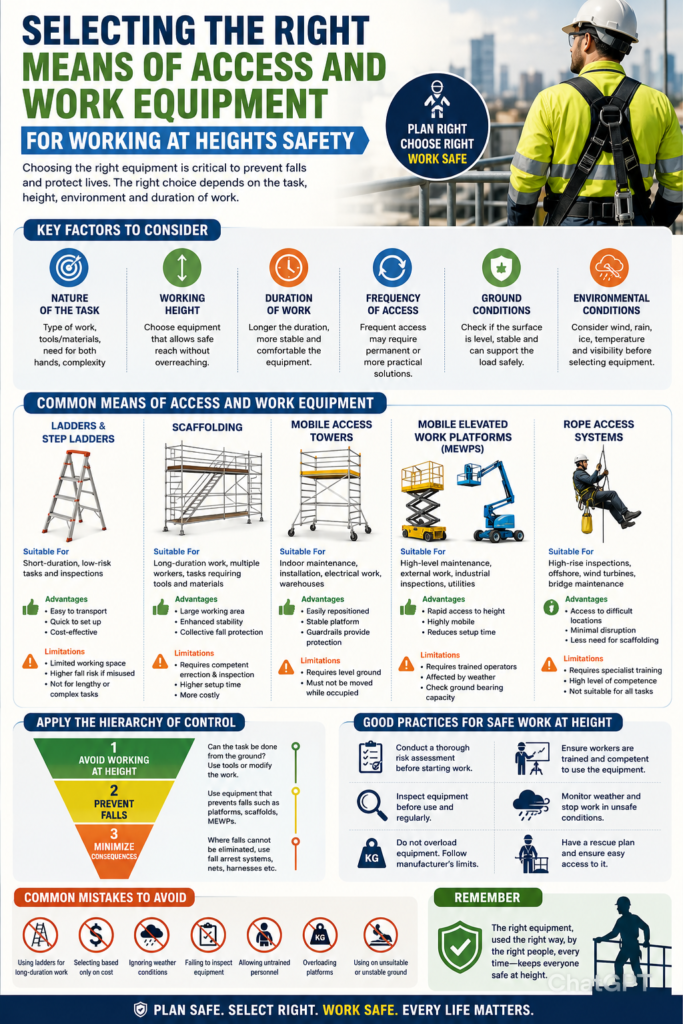
Understanding Working at Height
Working at height refers to any work where a person could fall from one level to another and sustain injury. This includes activities performed:
- On ladders
- On scaffolding
- On rooftops
- On elevated platforms
- Near floor openings or edges
- On fragile surfaces
- Using mobile elevated work platforms (MEWPs)
Before any work begins, a thorough assessment should determine whether working at height can be avoided altogether. If it cannot, suitable equipment and controls must be selected to minimize risk.
Key Factors When Selecting Access Equipment
Choosing the right means of access requires more than simply considering the height involved. Several important factors must be evaluated.
Nature of the Task
Consider the type of work being performed:
- Is it a short-duration inspection?
- Does it require both hands to perform the task?
- Will workers need tools or materials?
- Is frequent movement required?
The complexity and duration of the work often determine which equipment is most suitable.
Working Height
The height at which the task will be performed is a critical consideration. Equipment should allow workers to reach the work area safely without overreaching, stretching, or standing on unsafe surfaces.
Duration of Work
For brief and low-risk tasks, ladders may be appropriate. However, for longer-duration work, more stable working platforms such as scaffolds or elevated work platforms generally provide better protection.
Frequency of Access
Tasks requiring repeated access to elevated locations often justify the use of permanent access systems, stair towers, or platform solutions rather than portable equipment.
Ground Conditions
The stability of the ground or supporting surface directly affects equipment selection.
Questions to consider include:
- Is the surface level?
- Can it support the load?
- Is there a risk of subsidence?
- Are there underground services nearby?
Unstable ground can lead to equipment collapse or overturning.
Environmental Conditions
Weather conditions can significantly affect safety when working at height.
Factors include:
- Wind speed
- Rain
- Ice and snow
- Extreme temperatures
- Reduced visibility
Equipment that is safe in calm weather may become hazardous during adverse conditions.
Common Means of Access and Work Equipment
Ladders and Step Ladders
Ladders are among the most commonly used access equipment.
Suitable For:
- Short-duration work
- Low-risk tasks
- Light maintenance activities
- Inspections
Advantages:
- Easy to transport
- Quick to set up
- Cost-effective
Limitations:
- Limited working space
- Increased fall risk if misused
- Not suitable for lengthy or complex tasks
Workers should always maintain three points of contact and avoid overreaching while using ladders.
Scaffolding
Scaffolds provide a stable working platform and are widely used in construction and maintenance projects.
Suitable For:
- Long-duration work
- Multiple workers
- Tasks requiring tools and materials
- Building maintenance
Advantages:
- Large working area
- Enhanced stability
- Collective fall protection
Limitations:
- Requires competent erection and inspection
- Higher setup time
- Increased cost compared to ladders
Scaffolding should always be inspected by a competent person before use and after any event that may affect its stability.
Mobile Access Towers
Mobile towers offer flexibility while providing a safer alternative to ladders for many tasks.
Suitable For:
- Indoor maintenance work
- Installation projects
- Electrical work
- Warehouse operations
Advantages:
- Easily repositioned
- Stable work platform
- Guardrails provide fall protection
Limitations:
- Requires level ground
- Must not be moved while occupied
Mobile Elevated Work Platforms (MEWPs)
MEWPs include scissor lifts, boom lifts, and cherry pickers.
Suitable For:
- High-level maintenance
- External building work
- Industrial inspections
- Utility operations
Advantages:
- Rapid access to elevated areas
- High mobility
- Reduced setup requirements
Limitations:
- Requires trained operators
- May be affected by weather conditions
- Ground bearing capacity must be assessed
MEWPs often provide the safest and most efficient solution for many high-level work activities.
Rope Access Systems
Rope access techniques use specialized ropes and equipment to access difficult locations.
Suitable For:
- High-rise inspections
- Offshore facilities
- Wind turbines
- Bridge maintenance
Advantages:
- Access to difficult locations
- Minimal disruption
- Reduced need for scaffolding
Limitations:
- Requires specialist training
- Demands high levels of competence
- Not suitable for all tasks
Importance of Competence and Training
Even the best equipment can become dangerous when used incorrectly.
Workers must receive adequate training on:
- Equipment selection
- Safe operation
- Inspection procedures
- Emergency arrangements
- Rescue procedures
Supervisors should ensure workers understand equipment limitations and safe working practices before commencing any task.
Equipment Inspection and Maintenance
All work-at-height equipment should be inspected regularly.
Inspection requirements typically include:
- Pre-use checks
- Periodic formal inspections
- Maintenance according to manufacturer recommendations
Damaged or defective equipment should be removed from service immediately.
Common Mistakes to Avoid
Organizations frequently make the following mistakes:
- Using ladders for long-duration work
- Selecting equipment based solely on cost
- Ignoring weather conditions
- Failing to inspect equipment
- Allowing untrained personnel to operate equipment
- Overloading platforms
- Using equipment on unsuitable ground
Avoiding these common errors can significantly reduce the likelihood of accidents.